



Introduction
Is a Chihuahua tougher than a Rottweiler?
Is a Husky more sensitive than a Boston Terrier?
Many people have opinions on these types of breed-related differences. In a survey of over 1,000 veterinarians, 95% of respondents agreed that dog breeds differ in pain sensitivity. That sentiment was similarly reflected in a survey of the general public (also more than 1,000 respondents). However, veterinarians ranked breeds differently than the public with regard to pain sensitivity.
Until recently, there was no scientific evidence that dog breeds differ in their pain sensitivity. However, a team of AKC Canine Health Foundation (CHF) funded investigators at North Carolina State University College of Veterinary Medicine have published results from their groundbreaking study which may radically change how we understand canine pain. (CHF Grant 02797: Do Dog Breeds Differ in Pain Sensitivity?)
Key Points
- Pain sensitivity thresholds differ between dog breeds.
- Veterinarian beliefs about breed pain sensitivity often don’t match scientific findings.
- Emotional reactivity (like fear or anxiety) doesn’t fully explain pain sensitivity differences.
- The study used non-invasive sensory testing on 149 dogs across 10 breeds.
- Findings could lead to more personalized and effective pain management for dogs.
Challenge Background
Differences in pain sensitivity between dog breeds could have a major impact on how veterinarians diagnose and manage pain. If certain breeds experience pain differently due to physiological or genetic factors, treatments could be tailored to improve relief and reduce side effects.
However, if no true physiological differences exist, assumptions based on breed behavior or temperament could lead to misdiagnosis or inadequate care. Dogs seen as “tough” might not receive the pain relief they need, highlighting the importance of basing treatment decisions on evidence rather than perception.
The Breakthrough
Researchers used Quantitative Sensory Testing (QST) to measure pain sensitivity in dogs by applying controlled pressure and heat to their front legs and observing behavioral cues like pulling away or vocalizing. They also assessed emotional reactivity through simple behavioral tests, such as how dogs approached a mechanical toy and reacted to a disgruntled stranger, to help separate emotional responses from physical pain.
The results showed that pain sensitivity thresholds vary by breed and are not fully explained by emotional behavior. Interestingly, veterinarians’ beliefs about breed sensitivity didn’t match the scientific data and instead aligned more with how dogs behaved around the disgruntled stranger, suggesting that fear or anxiety during vet visits may influence perceptions of pain sensitivity. This highlights the need to base pain assessments on physiological evidence rather than behavioral assumptions.
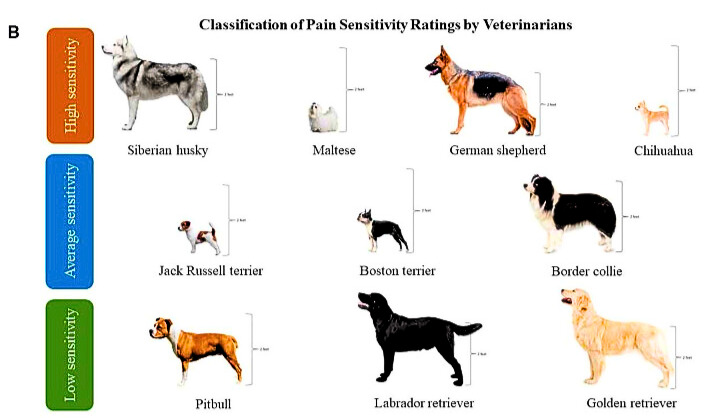
Figure 1B: Visual representation of the ten dog breeds/breed types selected based on the classification of pain sensitivity ratings by veterinarians. Height is demonstrated for each breed, as consideration was provided to include dog breeds/breed types of varying sizes. (From: Caddiell, R. M., Cunningham, R. M., White, P. A., Lascelles, B. D., and Gruen, M. E. (2023). Pain sensitivity differs between dog breeds but not in the way veterinarians believe. Front. Pain Res. https://doi.org/10.3389/fpain.2023.1165340)
Impact & Next Steps
This study marks a major step forward in how veterinarians recognize and treat pain in dogs. By confirming breed-specific pain sensitivity thresholds, independent of sex or behavior, it lays the groundwork for more personalized and effective pain management strategies. Researchers can now investigate the genetic and physiological mechanisms behind these differences, which could lead to improved diagnostic tools and targeted treatments.
As the science of canine pain management continues to advance, CHF is proud to fund groundbreaking studies such as this to help improve the recognition and treatment of pain and other diseases in the dogs we love. Learn more about this important research at akccchf.org/research.