A standard way to diagnose dog dementia. A vaccine approach to treat Chagas disease. The genetic cause of a rare disease in Basset Hounds. This year’s discoveries address questions that matter to the dogs we love and the people who care for them.
In 2025, the AKC Canine Health Foundation (CHF) launched the Canine Health Discovery of the Year Award to recognize the groundbreaking science redefining what is possible in canine health. Now in its second year, the award celebrates discoveries from researchers around the world that are advancing knowledge, opening new avenues for care, and shaping the future of dogs.
Illuminating Possibility
Nominations come from the people closest to the work: the peers, collaborators, and colleagues who recognize a discovery’s importance to canine health. From there, a selection committee of leading experts from around the world reviews the nominations and selects the discoveries with the greatest potential to advance the field. These are the findings that can deepen our understanding of disease, guide veterinary care, and open new directions for future research. Discoveries are eligible regardless of whether they received funding from CHF or another source.
This year’s semifinalists include discoveries that are already influencing veterinary care, as well as emerging findings that could shape its future. Together, they reflect the many ways scientific discovery advances canine health, from helping veterinarians make decisions today to opening new directions for tomorrow.
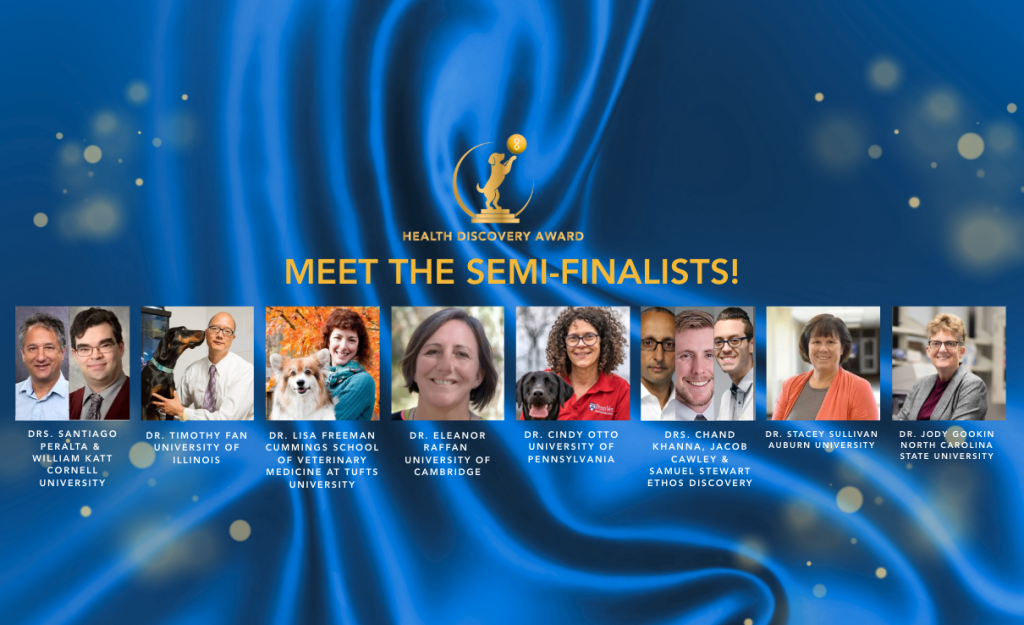
Meet the eight semifinalist discoveries selected for 2026.
The Eight 2026 Semi-Finalist Discoveries
1. First Standardized Guidelines for Diagnosing and Monitoring Dementia in Dogs
Dr. Natasha Olby, North Carolina State University, the Canine Cognitive Dysfunction Syndrome Working Group
Changes in sleep patterns, behavior, or daily routines can be early signs of canine cognitive dysfunction syndrome, often called dog dementia. An international working group developed the first standardized guidelines to help veterinarians recognize the condition, assess its severity, and monitor its progression. The framework provides a more consistent approach to diagnosis, helps rule out other possible causes, and supports conversations with dog owners. It also gives researchers a common language for comparing findings across studies and advancing our understanding of the disease.
2. Tick-Borne Disease Genomics Opens a Path to Better Tests and Future Vaccines
Dr. Sree Rajeev, University of Tennessee
Different tick-borne infections can require different approaches to treatment, making an accurate diagnosis essential. Researchers sequenced the genome of the bacterium Anaplasma platys and identified protein fragments from two tick-borne pathogens, Anaplasma platys and Ehrlichia canis, that trigger an immune response in dogs. Their findings provide promising targets for future diagnostic tests and vaccine development. More work is needed before those tools reach veterinary practice.
3. First Field Trial of a Vaccine to Treat Dogs Infected with Chagas Disease
Dr. Eric Dumonteil and Dr. Claudia Herrera, Tulane University
Chagas disease can damage a dog’s heart and shorten its life. In the first randomized field trial of its kind, researchers tested a therapeutic vaccine in dogs naturally infected with Trypanosoma cruzi, the parasite that causes the disease. Unlike traditional vaccines designed to prevent infection, this vaccine aimed to help the immune system fight an infection that was already present. Over six months, vaccinated dogs had lower parasite levels and better heart electrical activity. These encouraging early findings support further study of the vaccine as a potential treatment for Chagas disease in dogs.
4. Better Understanding of Leptospirosis Solidifies Recommendations that All Dogs Should Receive Annual Leptospirosis Vaccination
Dr. Jane Sykes; University of California, Davis, and Colleagues
Leptospirosis is a potentially fatal bacterial disease that can cause severe kidney and liver damage in dogs. Researchers found that leptospirosis is not just a concern for rural or outdoor dogs. The risk landscape is broader and changing, with cases occurring in small dogs and dogs living in urban areas. These findings helped build the evidence supporting broader vaccination recommendations. Today, the American Animal Hospital Association includes leptospirosis vaccination among its core recommendations for all dogs. Because the bacteria can also infect people, preventing the disease benefits both dogs and those who care for them
5. Study of 43 Breeds Finds New Genetic Variants Arise at a Steady Rate
Dr. Shao-Jie Zhang, Chinese Academy of Sciences; Dr. Jilong Ma and Dr. Meritxell Riera, Aarhus University; Dr. Elaine Ostrander, National Institutes of Health; Dr. Hannes Lohi, University of Helsinki
Every generation of dogs, like every generation of humans and other mammals, carries a small number of new genetic variants that arise naturally and are not present in either parent. Most are harmless, although some can contribute to inherited disease. By studying multigenerational dog families across 43 breeds, researchers found that these variants arise at a remarkably consistent rate across breeds of dogs despite generations of selective breeding. They also discovered that a sire’s age has a greater influence on the number of new variants passed to offspring than a dam’s age. The findings provide new insight into how genetic variation arises and is passed from one generation to the next, creating a stronger foundation for studying inherited disease and canine health.
6. Genetic Basis Identified for Glycogen Storage Disease in Basset Hounds
Dr. Kari Ekenstedt, University of Missouri; Dr. Jeanna Blake; Purdue University; Dr. Andrew Miller, Cornell University
Researchers identified a variant in the RBCK1 gene that causes a rare glycogen storage disease in Basset Hounds. The disease leads to abnormal glycogen accumulation in tissues, including the heart, which can affect health and quality of life. By pinpointing the genetic link, researchers enabled the development of genetic testing. A test can allow breeders to identify carriers and reduce the occurrence of the disease while maintaining genetic diversity in the breed.
7. Genetic Risk Factors for Stomach Cancer Found in Belgian Shepherd Breeds
Dr. Jacquelyn Evans, Cornell University
Stomach cancer is a devastating disease, and while it is not common across dogs, some closely related breeds develop it far more often than others. Researchers identified DNA regions linked to increased risk in Belgian Tervuren and Belgian Sheepdogs, along with potentially protective variants in Belgian Malinois. The findings suggest that risk is influenced by multiple genetic factors rather than a single gene. This work provides important clues about the biology of the cancer and gives scientists specific regions to investigate as they develop future risk-assessment tools for individual dogs.
8. Microbiome Transplants Improve Hard-to-Treat Chronic Gut Disease in Dogs
Dr. Carla Vecchiato, University of Bologna, and Dr. Jan Suchodolski, Texas A&M University
For some dogs, chronic digestive problems such as diarrhea, vomiting, weight loss, and poor appetite persist despite diet changes and other treatments. Chronic enteropathy is one of the most common causes of ongoing digestive problems in dogs, and some dogs continue to struggle despite diet changes and standard treatments. Researchers studied fecal microbiota transplantation (FMT), which introduces beneficial microorganisms from a carefully screened healthy donor dog. Dogs that received the treatment showed improvement in their clinical signs, suggesting FMT may offer a promising new option for dogs with difficult-to-manage gastrointestinal disease.
Follow the Discoveries
Over the next three weeks, we’ll introduce the scientists behind each discovery and take a closer look at what their findings mean for dogs.
Three finalists will be announced in November, and the 2026 Canine Health Discovery of the Year will be revealed at CHF’s Canines & Cocktails Gala on December 10, 2026.
By recognizing and sharing these discoveries, CHF helps connect the science happening in laboratories, clinics, and research centers around the world with the people who want healthier futures for dogs.
Thank you for supporting CHF’s mission to improve the health of all dogs through knowledge and discovery. We invite you to follow the honorees and share their stories with others who care about dogs.