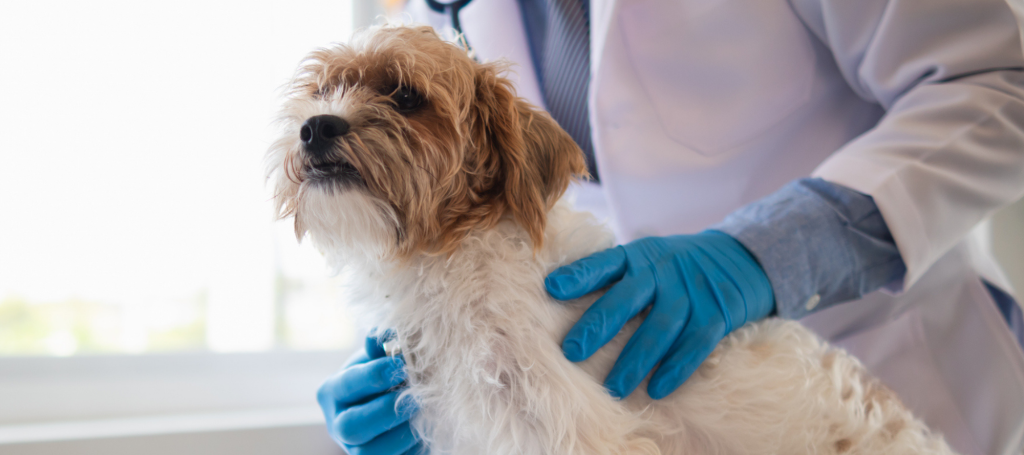



Myxomatous mitral valve disease (MMVD), or “leaky valve disease,” is the most common heart disease that dogs develop—and a leading cause of heart failure. Once a dog enters heart failure, the median survival time is just 11 months.
Medications can help manage symptoms and slow progression, but MMVD has no cure. And that comes down to one key challenge: despite how common it is, we still don’t fully understand what causes MMVD or what drives it to worsem over time.
Questioning A Long-Held Assumption
For years, MMVD has been believed to be a degenerative disease, not one driven by inflammation. Yet Dr. Vicky Yang, Associate Professor at Cummings School of Veterinary Medicine at Tufts University, is challenging that assumption.
With funding from the AKC Canine Health Foundation, Dr. Yang began examining diseased mitral valves at the cellular level, specifically looking for immune cells that might suggest inflammation plays a role after all.
What she found was striking.
Her recently published research revealed a significant increase in macrophages—immune cells that help regulate inflammation and tissue repair—in dogs with severe MMVD compared to dogs with no disease. Notably, the macrophages that increased are the type known for promoting tissue scarring, offering new insight into how the disease may progress.
“Human research has found evidence of inflammation being involved in similar diseases, like Barlow’s disease,” Dr. Yang explained. “So we asked: what about dogs? Are there inflammatory cells in canine MMVD? And that’s what we found.”
Going Deeper with Single-Cell Sequencing
Finding immune cells in diseased valves was only the beginning. The next and more complex questions address which immune cells are involved and what exactly they’re doing.
To answer that, Dr. Yang’s team is now using single-cell sequencing, an advanced genomic technique that allows researchers to analyze individual cells rather than averaging signals across thousands at once.
“The challenge is that there are so many types of macrophages,” Dr. Yang said. “We need to know which ones we’re seeing.”
By identifying the specific macrophage populations present in MMVD-affected valves, her team hopes to understand whether these immune cells are contributing to valve degeneration and, critically, how their activity might be slowed or stopped.
“We’ve been dealing with this disease for so long,” Yang noted, “but we don’t know enough yet. My hope is that single-cell sequencing gives us a full picture of how cells change when disease occurs. Because then we know what we need to target.”
Research, From the Heart and for the Heart
This is what Hearts to Heal looks like in practice: asking better questions, challenging long-standing assumptions, and using cutting-edge tools to uncover new paths forward— all to help dogs live longer, healthier lives.
Throughout February, CHF is highlighting researchers like Dr. Yang, scientists whose work brings us closer to understanding, treating, and one day preventing heart diseases like MMVD.
This progress is only possible because donors believe in discovery before certainty and in science before solutions are fully formed. To learn more or support the work we are doing to advance the health of all dogs visit akcchf.org/donate.