

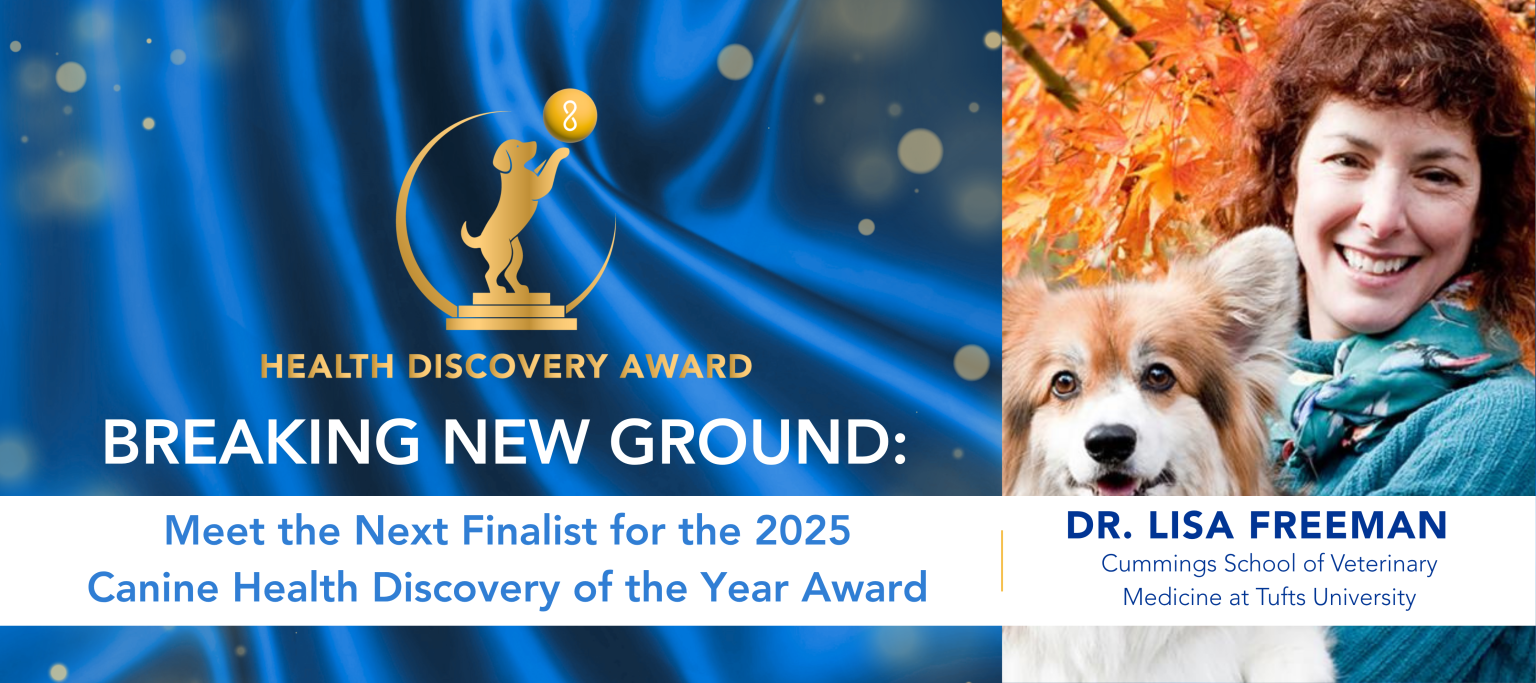
Dr. Lisa Freeman - Finalist for the 2025 Canine Health Discovery of the Year Award
Diet-associated dilated cardiomyopathy is one of the most pressing unanswered questions in modern veterinary medicine and few people feel that weight more personally than Dr. Lisa Freeman. For years, she has been driven by a simple but profound question: Why are dogs with no predisposition developing a life-threatening heart disease?
Dilated cardiomyopathy isn’t a new concern, but a new form of the disease appeared in the last decade. In 2018, the FDA announced an investigation into a potential link between certain pet diets (those containing a high proportion of peas, lentils, other legume seeds, or potatoes) and a rising number of diet-associated DCM cases. For veterinarians like Dr. Freeman, it intensified a scientific puzzle that had life-or-death consequences for beloved pets.
“I feel a real sense of urgency with this research. These are people’s beloved pets that are affected,” said Dr. Freeman, professor and veterinary nutritionist at Cummings School of Veterinary Medicine at Tufts University. “I don’t want more dogs to suffer. And for the dogs and owners already affected…I want to do justice for them.”
In January 2025, her team published groundbreaking findings that may represent a turning point in the field. After years of work, this study delivered a concrete molecular clue to a mystery that has long frustrated veterinary researchers. For the first time, Dr. Freeman identified a biological marker that offers a plausible mechanism for diet-associated DCM.
Her study found that dogs with DCM eating diets high in pulses (peas, lentils, chickpeas, beans) had significantly elevated concentrations of a urinary biomarker tied to phospholipidosis, a condition that can cause cellular and organ dysfunction.
This discovery doesn’t just deepen scientific understanding, it opens a long-sought after new investigative path. It gives researchers a measurable, biologically meaningful clue that could explain how and why the disease develops, as well as better treatments for affected dogs.
“I don’t hope – I know she will bring more answers about why this is happening,” said William Bousquet, a cardiology intern working alongside Dr. Freeman. “And those answers will be incredibly important.”
For her relentless pursuit of answers and her landmark contribution to unraveling one of canine health’s most challenging mysteries, Dr. Lisa Freeman is named a Finalist for the 2025 Canine Health Discovery of the Year Award.