

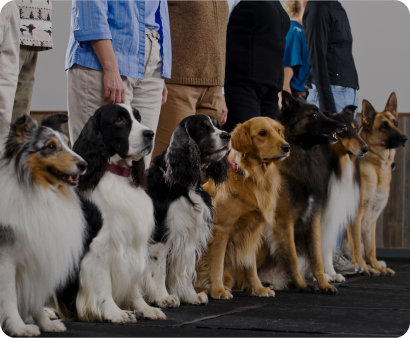




Celebrating the Breakthroughs Shaping the Future of Canine Health. Meet the 2025 Canine Health Discovery Award Finalists.

Advancing Canine Health Together

We value collaboration in advancing canine health. Through our Donor-Originated Grant (DOG) program, organizations can partner with us to fund important research initiatives that improve the health and well-being of dogs.

All projects funded through this program must align with CHF’s mission, vision, and canine health priorities.

Why Pursue DOGs?

Expert Grant Administration

Benefit from our expert grant administration and oversight, ensuring funds are used efficiently and effectively.

Regular Updates and Outcomes

Stay informed with regular progress reports and final outcomes to see the impact of your contribution.

Benefit from Rigorous Scientific Review

Ensure your investment supports the most promising and scientifically rigorous research through our thorough peer review process.

Dedicated Support

Receive ongoing assistance from our scientific team throughout the grant process, ensuring that your research objectives are achieved.

Directly Address Canine Health Concerns

Direct your funding to specific areas of canine health research, including breed-specific or donor-focused health concerns.

Key Benefits

Join us in advancing scientific discoveries that improve the health and well-being of all dogs.

Financial Stewardship and Transparency

As part of our commitment to responsible stewardship of donor funds, we require regular financial reports for each donor-originated grant, ensuring full accountability. Donors can trust that their funds are managed with care and that all research aligns with CHF’s mission and canine health priorities.

Collaboration and Communication

Throughout the research process, CHF will facilitate communication between the donor and the investigator, providing regular updates on scientific progress. If the project generates educational or promotional materials, we will work with both the donor and the investigator to ensure the correct dissemination of information to support our shared goals.

Trust in the Scientific Review Process

While donor involvement is vital in supporting the research, all grant proposals will go through our standard review process, involving experts in canine health. While we strive to align research with donor interests, we cannot guarantee approval of every proposal. However, we ensure that each project is scientifically rigorous, aligned with CHF’s mission, and has the potential to make a significant impact on canine health.

We look forward to collaborating with you to advance the health and well-being of dogs through science and innovation.

If you’re interested in partnering with CHF on a DOG, please feel contact us. Donors can download the full document outlining the program’s process, benefits, and steps to get started.

Grants

Cornell University Logo
2026 Active Grant
Sports Medicine & Rehabilitation Residencies $299,984.00
03458-E: Cornell University 2026 Canine Sports Medicine & Rehabilitation Residency
Breed(s): All Dogs
Researcher(s): Christopher W. Frye, DVM, DACVSMR, CVA
2026 Active Grant
Theriogenology Residencies $128,883.00
03459-E: University of Missouri 2026 Small Animal Theriogenology Residency
Researcher(s): Julia M. Baldrighi,, DVM, PhD
2026 Active Grant
Theriogenology Residencies $149,979.00
03461-E: The Ohio State University 2026 Small Animal Theriogenology Residency
Breed(s): All Dogs
Researcher(s): Dr. Erin E Runcan, DVM
North Carolina State University Logo
2026 Active Grant
Kidney & Urological Disease $121,165.15
03463: Efficacy of Alkaline Therapy as a Treatment of Metabolic Acidosis in Dogs with Chronic Kidney Disease
Breed(s): All Dogs
Researcher(s): Autumn N Harris, DVM, DACVIM
University of Minnesota Logo
2026 Active Grant
Kidney & Urological Disease $127,166.00
03572: The impact of genetic, metabolic, and clinical risk factors for calcium oxalate urolith recurrence in dogs
Breed(s): All Dogs
Researcher(s): Eva Furrow
2026 Active Grant
Epilepsy $15,237.50
03635-A: Epidemiology and clinical features of idiopathic epilepsy in Irish Wolfhounds: A questionnaire-based cross-sectional study
Breed(s): Irish Wolfhound
Researcher(s): Yoshihiko Yu

2026 Active Grant
Ophthalmology $29,441.00
03670-A: The Molecular Genetic Basis for Progressive Retinal Atrophy in Berger Picard Dogs
Breed(s): Berger Picard
Researcher(s): Martin L. Katz, PhD
University of Guelph Logo
2026 Active Grant
Neurology $14,285.88
03681-A: Clinical Utility of Quantitative Pupillometry in Dogs
Breed(s): All Dogs
Researcher(s): Alex Chan
2026 Active Grant
Neurology $23,035.00
03467-A: Validation of Circulating microRNA Biomarkers to Predict Neurologic Outcomes in Dogs with Severe Spinal Cord Injury
Breed(s): All Dogs
Researcher(s): Dr. Ji-Hey Lim, DVM, PhD
Michigan State University Logo
2026 Active Grant
General Canine Health $28,484.35
03574-A: Development of an Antibiotic Susceptibility Protocol and Genetic Characterization of Canine Mycoplasmas
Breed(s): All Dogs
Researcher(s): Rinosh Joshua Mani
2026 Active Grant
Epilepsy $21,620.00
03659-A: Evaluating Long-chain Fatty Acids as a Nutritional Biomarker in Canine Idiopathic Epilepsy.
Breed(s): Australian Shepherd
Researcher(s): Go Togawa, DVM MSc PhD

2026 Active Grant
General Canine Health $18,000.00
03732-R: Translational Research Immersion Program (TRIP) 2026
Breed(s): All Dogs
Researcher(s): Starr Cameron, BVetMed
University of California, Riverside Logo
2026 Active Grant
Infection & Immunity $209,770.00
3385: Prevalence and Risk Assessment of Heterobilharzia americana in Dogs and Freshwater Sources in the Southwestern United States
Breed(s): All Dogs
Researcher(s): Adler R Dillman, PhD
Arizona Board of Regents, University of Arizona Logo
2026 Active Grant
Nervous System Health $191,081.00
03576: Protective Role for Insulin-like Growth Factor 1 (IGF-1) in Canine Cognitive Dysfunction
Breed(s): All Dogs
Researcher(s): Evan MacLean, PhD
2026 Active Grant
Oncology - Lymphoma $29,900.00
03474-A: Engineering Cytokine-Receptor–Enhanced CAR T Cells to Achieve Long-Term Persistence and Durable Remission in Canine B-Cell Lymphoma
Breed(s): All Dogs
Researcher(s): Anthony J Mutsaers, DVM, PhD