


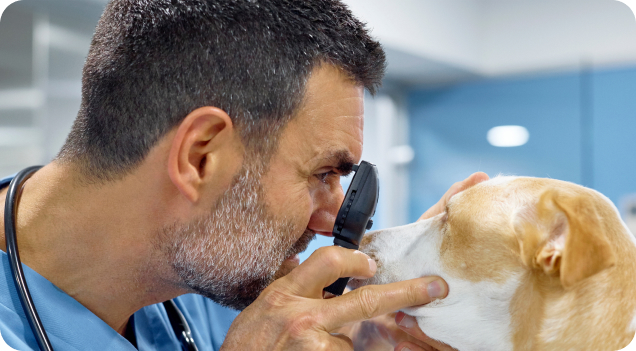
Eye Health Research
The AKC Canine Health Foundation (CHF) funds research to better understand and treat diseases of the canine eye and visual system.
Read MoreCanine Eye Health
Dog owners rely on general practice veterinarians to help maintain their pet’s overall health and well-being. Some conditions, however, require specialized care that falls outside the scope of what general practice veterinarians can provide. In these cases, specialists must be consulted. A veterinary specialist is a veterinarian who has completed additional training and passed an […]
Read More
Hormonal Health Research
The AKC Canine Health Foundation (CHF) supports research into diseases of the endocrine system, focusing on genetic causes, stem cell therapies, novel diagnostics, and potential treatments for hormonal disorders.
Read More
Philanthropy Improves the Health of Golden Retrievers
MEDIA CONTACT:Sharon AlbrightManager of Communications and Veterinary OutreachAKC Canine Health FoundationPhone: 919-334-4019Email: Sharon.Albright@akcchf.org News Release For Immediate Release RALEIGH, NC (September 16, 2019) – The AKC Canine Health Foundation (CHF) has a long-standing relationship with the Golden Retriever Foundation (GRF) to support their dedication to improving the health of Golden Retrievers. The Golden […]
Read MoreDonor-Originated Grants
Go Back Donor-Originated Grants (DOGs) Join the AKC Canine Health Foundation (CHF) by directly supporting groundbreaking research that addresses the health needs you care about most. Inquire Now × Donor Originated Grants Advancing Canine Health Together We value collaboration in advancing canine health. Through our Donor-Originated Grant (DOG) program, organizations can partner with us to […]
Read MoreOak Grants
Oak Grants These grants support large-scale research projects requiring more than $30,000 in funding, with an emphasis on scientific discovery to address canine health priorities. Request for Proposal Application Guidelines Selection Process Funding Eligibility Grant Reporting Requirements Purpose of this Grant The Oak Grants – named after Raleigh, NC, the “City of Oaks” and headquarters […]
Read More
Vision Loss in Golden Retriever Pigmentary Uveitis
Introduction Golden Retriever Pigmentary Uveitis (GRPU) is an eye condition that can affect Golden Retrievers as they age. It often develops slowly and may not show obvious signs at first, but over time it can lead to serious complications like glaucoma and vision loss. Recent research led by Dr. Wendy Townsend at Purdue University offers […]
Read MoreEarly Career Investigator
Go Back Early Career Investigator Program This program supports individuals in the first stage of their career as independent investigators focused on improving health outcomes for dogs. This award is designed to foster research that advances the health of dogs while also investing in the careers of the next generation of veterinary scientists. Request for […]
Read More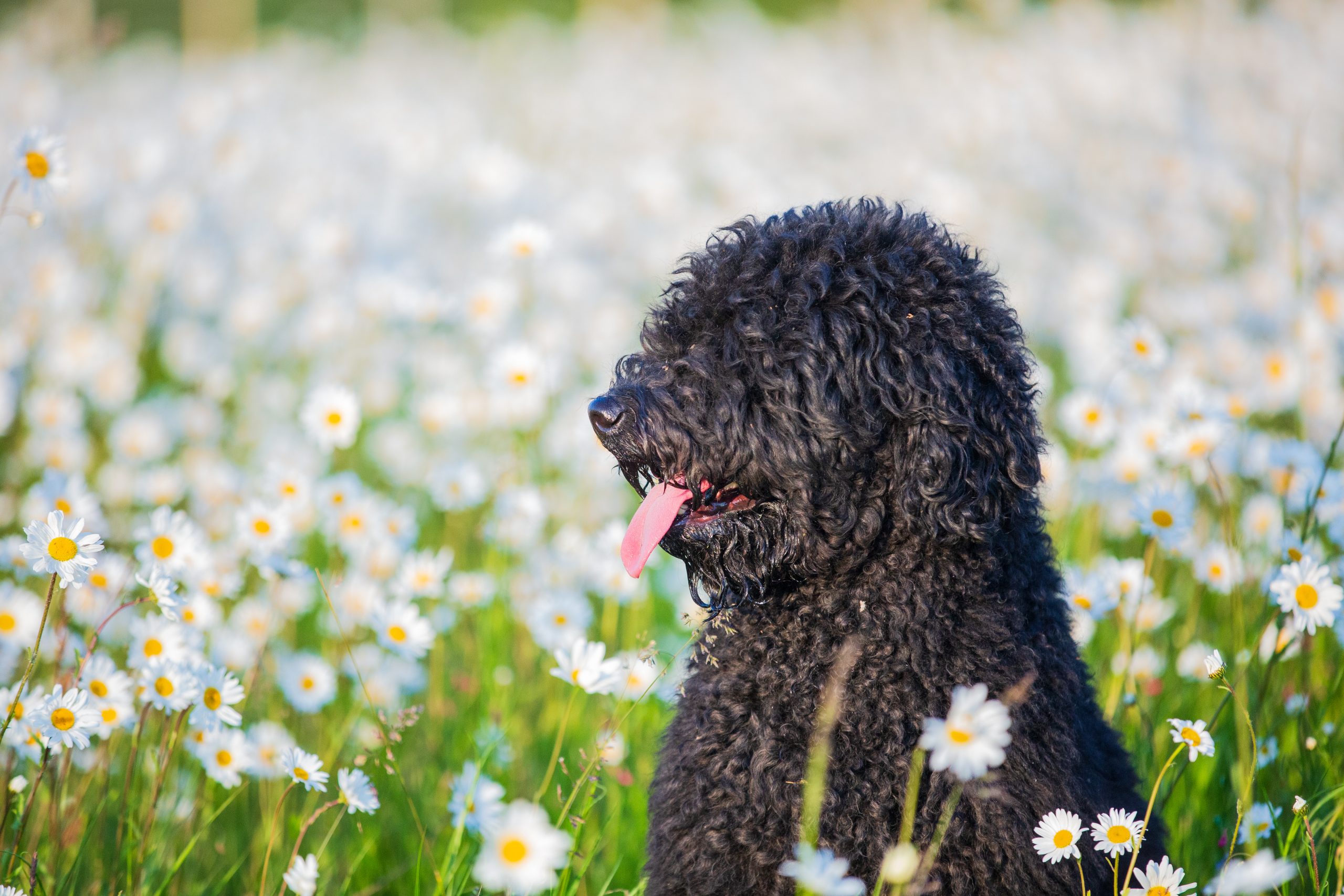
Collaboration Leads to Solutions for Heritable Disease – Microphthalmia Syndrome in the Portuguese Water Dog
Introduction The AKC Canine Health Foundation (CHF) has long supported the health of all dogs by funding scientific research and sharing trusted health information. Through strong partnerships with breed Parent Clubs, CHF helps researchers explore inherited conditions that affect specific breeds—leading to better diagnostics, treatments, and breeding practices. One example of this collaboration in action […]
Read MoreAnn Viklund – Dedicated to Animal Health
Ann Viklund joined the AKC Canine Health Foundation (CHF) Board of Directors in 2013 and served as its Secretary until 2018. She received CHF’s President’s Award in 2017 honoring her exceptional contribution to advancing canine health. She is the Director of Conformation for the Purina Professional Engagement Team and serves as a valued liaison between […]
Read MoreSmall Animal Theriogenology
Small Animal Theriogenology Residency This residency program provides support to increase the number of veterinary professionals with expertise in theriogenology–the study of reproduction in animals–with a focus on dogs. Request for Proposal Application Guidelines Selection Process Funding Elgibility Grant Reporting Requirements Purpose of this Residency Program This program, a partnership between the American Kennel Club, […]
Read MoreClinician-Scientist Fellowship
Clinician-Scientist Fellowships Fellowships provide trainees with the opportunity for mentored support to bridge clinical practice and scientific research. Request for Proposal Application Guidelines Selection Process Funding Elgibility Grant Reporting Requirements Purpose of this Grant Program The Clinician-Scientist Fellowship aims to cultivate the next generation of veterinary researchers by supporting veterinarians who are eager to combine […]
Read MoreAKC Canine Health Foundation Funded Study of 9/11 Search and Rescue Dogs Enters its Fourteenth Year
At 16-and-a-half years of age, Morgan, an English Springer Spaniel, continues to lead a fairly active life. According to Katrene Johnson, Morgan’s handler, “She goes out to the barn with me several times every day, rambles with me and the other dogs on the trails once or twice a week, and still plays a little […]
Read More Diagnostic Criteria for Golden Retriever Pigmentary Uveitis
Introduction Golden Retriever Pigmentary Uveitis (GRPU) is a serious eye disease that affects many older Golden Retrievers across the U.S. and Canada. It can lead to painful glaucoma and even blindness if not caught early. Thanks to new research supported by the AKC Canine Health Foundation and led by the ACVO Genetics Committee, veterinarians now […]
Read MoreCanine Sports Medicine
Canine Sports Medicine & Rehabilitation Residency Program This program supports the residency training of veterinarians seeking to attain board certification in the field of canine sports medicine and rehabilitation through the American College of Veterinary Sports Medicine and Rehabilitation (ACVSMR). Request for Proposal Application Guidelines Selection Process Funding Elgibility Grant Reporting Requirements Purpose of this […]
Read More
Exploring New Treatments for a Painful Eye Disease – Corneal Endothelial Dystrophy
Introduction If your dog has ever struggled with cloudy eyes or vision loss, you know how heartbreaking it can be. A condition called corneal endothelial dystrophy (CED) is one culprit—and it’s both painful and difficult to treat. Researchers funded by the AKC Canine Health Foundation are exploring new ways to manage this disease. Their latest […]
Read More03094-MOU: Identification of Gene Mutation Underlying Ocular Melanosis in Cairn Terriers
Ocular Melanosis (OM) is an important cause of vision loss and pain in the Cairn Terrier breed. It is an inherited condition and there is a need for a genetic test to allow dog breeders the opportunity to eradicate the condition. The condition develops in both eyes and results from a proliferation of pigmented cells […]
Read More00763: Capsular Tension Ring Effect on Canine Lens Epithelial Migration and Post-Operative Lens Capsule Opacification
The study “Capsular tension ring effect on canine lens epithelial migration and post-operative lens capsule opacification” is a two-part study looking at the behavior of lens epithelial cells (LEC) and lens capsule scarring in response to capsular tension ring (CTR) placement during cataract surgery. 100% of dogs undergoing cataract surgery develop some degree of capsule […]
Read More02145-A: Prevention of Glaucoma and Goniodysgenesis through Genetic Profiling of Disease
Primary glaucoma is a painful and blinding disease associated with high pressure inside the eye. Glaucoma affects over 40 breeds of dogs worldwide, at least 1500 dogs in the UK each year and in the USA as many as 15,000 dogs per year could be affected. Treatment is usually unsuccessful and most affected dogs ultimately […]
Read MoreExploring Genetic Causes of Glaucoma in the American Cocker Spaniel
Glaucoma is a group of eye diseases that damage the optic nerve and ultimately result in irreversible vision loss. Primary angle closure glaucoma (PACG) is the most common form of glaucoma in dogs. It is caused by blockage of the ‘drain’ between the iris (the colored part of the eye) and cornea (the transparent surface […]
Read More